

Changing your hair color can completely alter the way your face looks.
The right shade can make your eyes appear more noticeable and your complexion look more balanced. The wrong one can feel strangely disconnected, even when the color itself looked beautiful on someone else.
That is because choosing hair color is not simply a matter of deciding whether you want to be blonde, brunette, red or black.
The exact version of that color matters.
A cool espresso and a warm chocolate brown can create very different effects around the same face. So can golden blonde and ash blonde, or clear copper and muted auburn.
Before choosing your next shade, it helps to understand what actually makes a hair color feel harmonious.
Start With Direction, Not a Celebrity Photo
Inspiration photos are useful, but they can also create unrealistic expectations.
The color you are looking at exists alongside someone else’s skin, eyes, brows and natural contrast. Lighting, filters and professional styling can change its appearance even further.
Instead of trying to copy an exact photograph, identify what you like about it.
Is it the depth?
The warmth?
The brightness?
The contrast created by lighter pieces around the face?
Once you understand the characteristics you are responding to, a stylist can translate the idea into something that works with your own coloring.
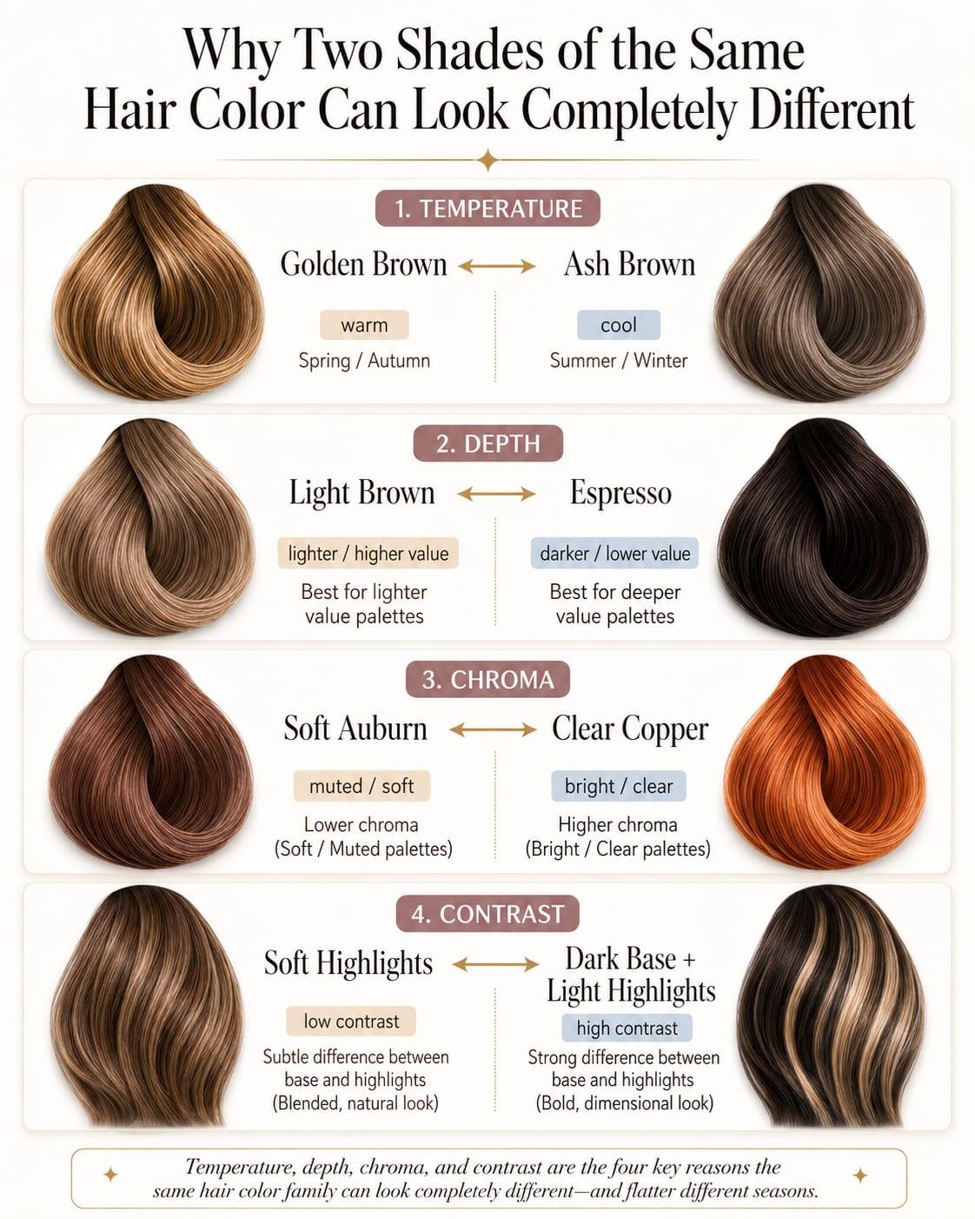
Hair color can vary by temperature, depth, chroma and contrast. Graphic: ColorPaletteAnalysis.com
Warm and Cool Versions of the Same Color Behave Differently
Hair-color names are surprisingly broad.
“Brown” could mean golden brown, caramel, chestnut, mushroom brown, ash brown, chocolate or espresso. Blonde could range from honey and beige to icy platinum.
One of the biggest differences between these shades is temperature.
Warmer colors contain more golden, yellow, orange or red influence. Cooler colors tend towards ash, violet, blue or smoky tones.
That distinction can change the relationship between your hair and complexion dramatically.
Someone who looks balanced in a cool brunette may find that a strongly golden brown makes the skin appear more yellow. Another person may have exactly the opposite experience and find that very ashy shades make the complexion look flat.
The important question is therefore not simply, “Does brown suit me?”
It is, “Which brown suits me?”
Depth Can Matter as Much as Undertone
People often concentrate on warmth and coolness while overlooking how light or dark the hair should be.
Yet hair creates a large block of color directly around the face.
Moving several levels lighter or darker can therefore change your appearance even when the undertone is correct.
Someone whose natural features have considerable depth may feel washed out after going extremely light. Someone with much lighter overall coloring may find very dark hair dominates the face.
This doesn’t mean you cannot make a dramatic change. It simply means that the further you move from your natural depth, the more consciously you may need to manage the resulting contrast.
Think About the Contrast Around Your Face
Contrast describes how much visual difference exists between your features.
Dark hair against considerably lighter skin creates stronger contrast than light brown hair against similarly light-to-medium features. Brows, eyes and even the whites of the eyes contribute to the overall effect.
Changing your hair can increase or reduce that contrast very quickly.
This is one reason a technically attractive shade can still feel wrong.
Choosing a flattering shade involves more than deciding between blonde, brunette or red. A hair color analysis considers factors such as temperature, depth, contrast and color intensity in relation to your natural coloring before narrowing down the most promising shade directions.
That gives you something more useful than a single trendy color name.
It gives you a framework for comparing options.
Clear Versus Muted Color Changes the Effect Too
Another factor that receives less attention is intensity.
Some hair colors look rich, clean and glossy. Others have a softer, smokier or more muted appearance.
Compare a glossy blue-black with a softer charcoal-black, or a bright copper with a subdued cinnamon brown.
Neither approach is universally better.
Someone whose coloring naturally has a softer quality may find an extremely intense hair shade draws attention away from the face. Someone who carries stronger, clearer contrast may look more defined with richer color.
This is why choosing between two shades that appear similar on a salon chart can matter more than expected.
Your Natural Hair Is Useful Information
Even if you want to change your natural hair completely, do not ignore it.
Your original color provides clues about the depth and contrast that already exist naturally around your face.
It also matters technically.
A stylist needs to know your natural level, existing artificial color and previous treatments before deciding how realistic a result will be.
Going from medium brown to a slightly cooler brunette is a very different process from moving from permanent black dye to pale blonde.
The flattering color and the achievable color have to meet somewhere in the middle.
Do Not Let Your “Season” Become a Rule Book
Seasonal color analysis can provide useful guidance for hair because it organizes colors according to characteristics such as temperature, depth and intensity.
But a seasonal label should be treated as direction rather than a box.
Two people within the same broad season do not necessarily need identical hair.
Natural depth, individual contrast, gray coverage, existing color and personal preference still matter.
A better approach is to understand why certain shade families belong to your palette and then use that information in conversation with your stylist.
That allows the result to remain personal rather than formulaic.
Consider Maintenance Before Falling in Love With a Shade
The most flattering color in theory is not always the best color for your lifestyle.
A dramatic change can require regular root appointments, toning, glossing or additional treatments to maintain the intended result.
Very light blonde on naturally dark hair, for example, usually creates a different maintenance commitment than shifting within the brunette family.
Likewise, certain reds can fade noticeably between appointments, while cooler shades may need toning to prevent unwanted warmth from becoming visible.
- How often will the color need refreshing?
- What happens as my natural roots grow in?
- Will I need regular toner or gloss?
- How will the shade fade?
- Can I maintain the result within my budget and routine?
A color that still looks good six weeks later may ultimately be a better choice than one that only looks perfect when freshly done.
Bring a Direction to Your Stylist, Not a Formula
Knowing which colors harmonize with you does not replace a professional hair-colorist.
The two jobs solve different problems.
Color analysis can help identify the aesthetic direction: warmer or cooler, lighter or deeper, clearer or softer.
A stylist has to translate that direction into an actual result while considering your starting level, underlying pigment, hair condition, previous dye and how much lift is safely possible.
That distinction is important.
An ash blonde may be a flattering idea but technically difficult to achieve in one appointment. A deep brunette might suit your coloring but need to be adjusted so that it does not appear unnaturally flat.
Bring your stylist the direction you want, then let them determine how best to create it.
The Best Hair Color Still Looks Like You
Hair trends change constantly.
One year may favor expensive brunette, another copper, another icy blonde or high-contrast highlights.
There is nothing wrong with experimenting with trends.
The trick is adapting the trend rather than copying it exactly.
A warmer person might reinterpret a brunette trend with chestnut or caramel tones. Someone who needs cooler color might move towards mushroom, ash or espresso instead. A person who suits softer coloring may choose blended dimension where someone with greater natural contrast might prefer a sharper result.
Once you understand the qualities that work around your face, you gain much more freedom-not less.
You no longer need to ask whether you are “allowed” to wear blonde, brown, red or black.
You can ask the much more useful question:
Which version of that color works best on me?